

ζ Portfolio Update: April/26 Rebalancing
Closing the Month: What Real Data Teaches Us About Patience and Process
The market is sending clear signs of a cycle reversal. Moments like this are inevitable in variable income investing, and precisely because of that, they deserve more clarity than anxiety.
This article is about process. About what auditable data says when market noise tries to speak louder.
The four possible outcomes of any position
Every position can end in one of four ways: a large profit, a small profit, a small loss, or a large loss. Risk management exists to systematically eliminate the fourth option. The other three are part of the game.
No serious strategy promises that every trade will be a winner. In fact, statistically speaking, roughly half of all positions will be profitable, and that is perfectly fine, as long as the methodology is sound.
What the data actually shows
These are not backtested numbers. The figures below come from verifiable, audited data going back to September 2021:
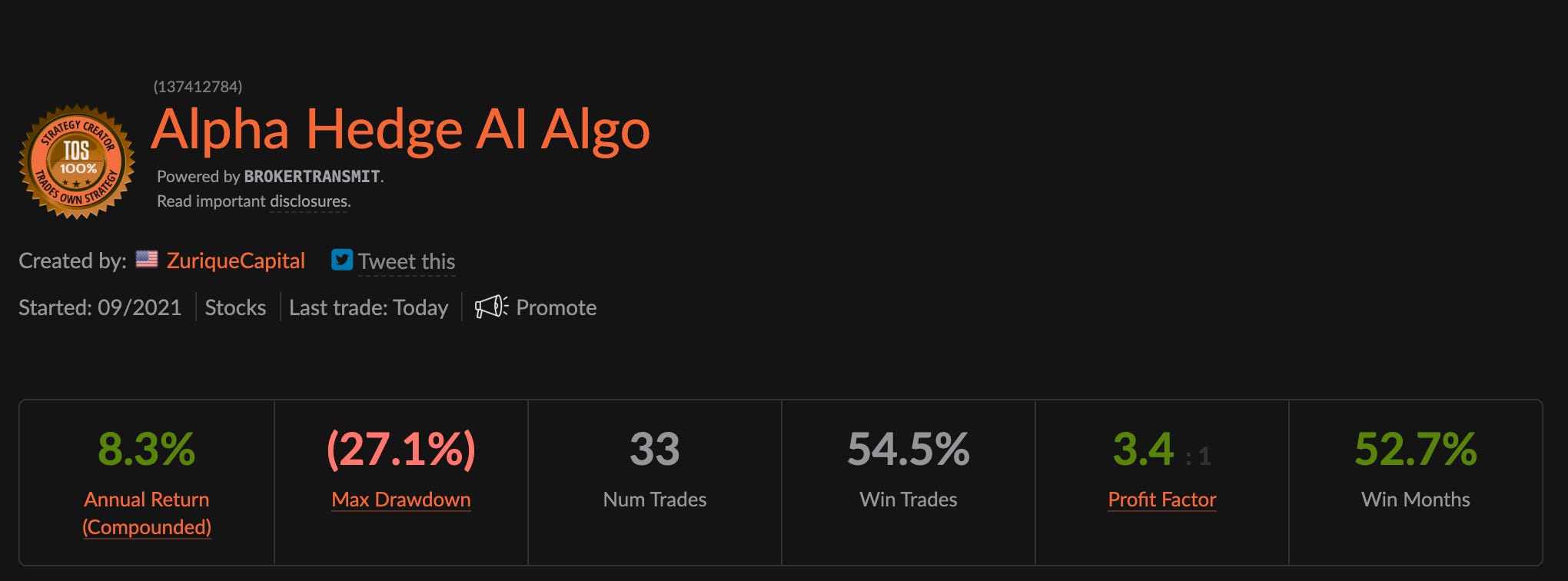
Win rate: approximately 54%
Profit factor: 3.4 to 1
Maximum drawdown: 27.1% in aggressive mode
The 3.4:1 profit factor means that for every dollar lost over the period, 3.4 were gained. This does not require every single trade to be a winner, it requires the process to be consistently executed.
Swinging for home runs
Many people compare financial markets to poker, the bluffing, the strategy, the math. There is some validity to that comparison. But a better analogy, in my view, is baseball.
Consider Aaron Judge, one of the most dominant hitters in recent memory. In his record-breaking season, he hit 62 home runs, a historic achievement. Yet his contact rate that year was around 31%. That means he was retired, struck out, more often than he connected. The opposing crowd cheered every time he missed, precisely because everyone knew what happened when he did connect: the ball left the stadium.
That is the strategy. Not hitting safely every at-bat, but making the hits that count matter enormously. You can choose a different approach, buy and hold the S&P 500 index, collect steadier, more modest returns, and accept the occasional 50% drawdown like the one seen in 2008. That is a legitimate path. But it is not a path built for home runs.
The focus here is on swinging for the fences. That means missing sometimes. It means standing at the plate with the bases loaded, maximum potential on the table, and still striking out. It hurts. Anyone who has watched their team leave runners stranded knows exactly how that feels. But it is part of the game, and the strategy only works if you stay in the batter’s box.
The illusion of loss and the reference point bias
One of the greatest enemies of an investor is not found in the market, it is found in perception. When a position that was generating profit pulls back, the mind registers the distance between the peak and the current value as a “loss,” even if the final result is still positive or only slightly negative.
This is a well-documented cognitive bias known as the reference point effect, and it leads many investors to make emotional decisions at exactly the wrong moment. A common reaction in periods like this is to move capital out of variable income and into fixed income, to seek safety after a scare. But making allocation decisions based on a recent event is the same logic that makes people afraid to fly after a plane crash. The event is real, the emotion is understandable, but the statistical reasoning behind the decision is flawed.
The strategy does not change because the market had a rough month. The strategy exists precisely for months like this one.
Transparency as a competitive advantage
Here is something counter-intuitive worth sitting with: periods of underperformance, when handled with honesty, build more credibility than a spotless track record ever could.
Many firms and fund managers quietly shelve strategies that are not performing and spotlight the ones that are doing well at any given moment. The result is a curated image of perpetual success that simply does not reflect reality. Institutional investors know this game, and they discount it accordingly.
Showing that a strategy genuinely fluctuates, that it underperforms the S&P 500 during certain cycles, that it has drawdowns, that not every position closes in profit, signals something far more valuable: that the results are real. In 2022, for example, when the broader market fell nearly 19%, a 5% positive return represented a meaningful outperformance. That kind of data point only has weight because it sits alongside periods where the numbers were harder to show.
Transparency is not a concession. It is the foundation of a strategy worth trusting over the long term.
Patience without complacency
There is an important distinction between patience and passivity. Patience means trusting the process while it is being executed with rigor. Complacency would be accepting any outcome without scrutiny or adjustment.
Executing the same methodology every single day, with discipline, without shortcuts, without letting emotions override the plan, is what separates accidental results from replicable ones. The bases may be loaded. The pitch may not come. But the next at-bat is always on its way.
A difficult month does not erase a methodology that works over the long term. The next home run begins with the consistency of today.
Closing a month under market pressure is a test of the process, not a negation of it. The auditable data exists precisely for moments like this, a reminder that one rough cycle does not define what a sound, long-term approach is capable of delivering.
Unlock the Alpha Hedge AI Algo Portfolio ↓